None of them lied to you. They quoted three different projects and called them the same thing.
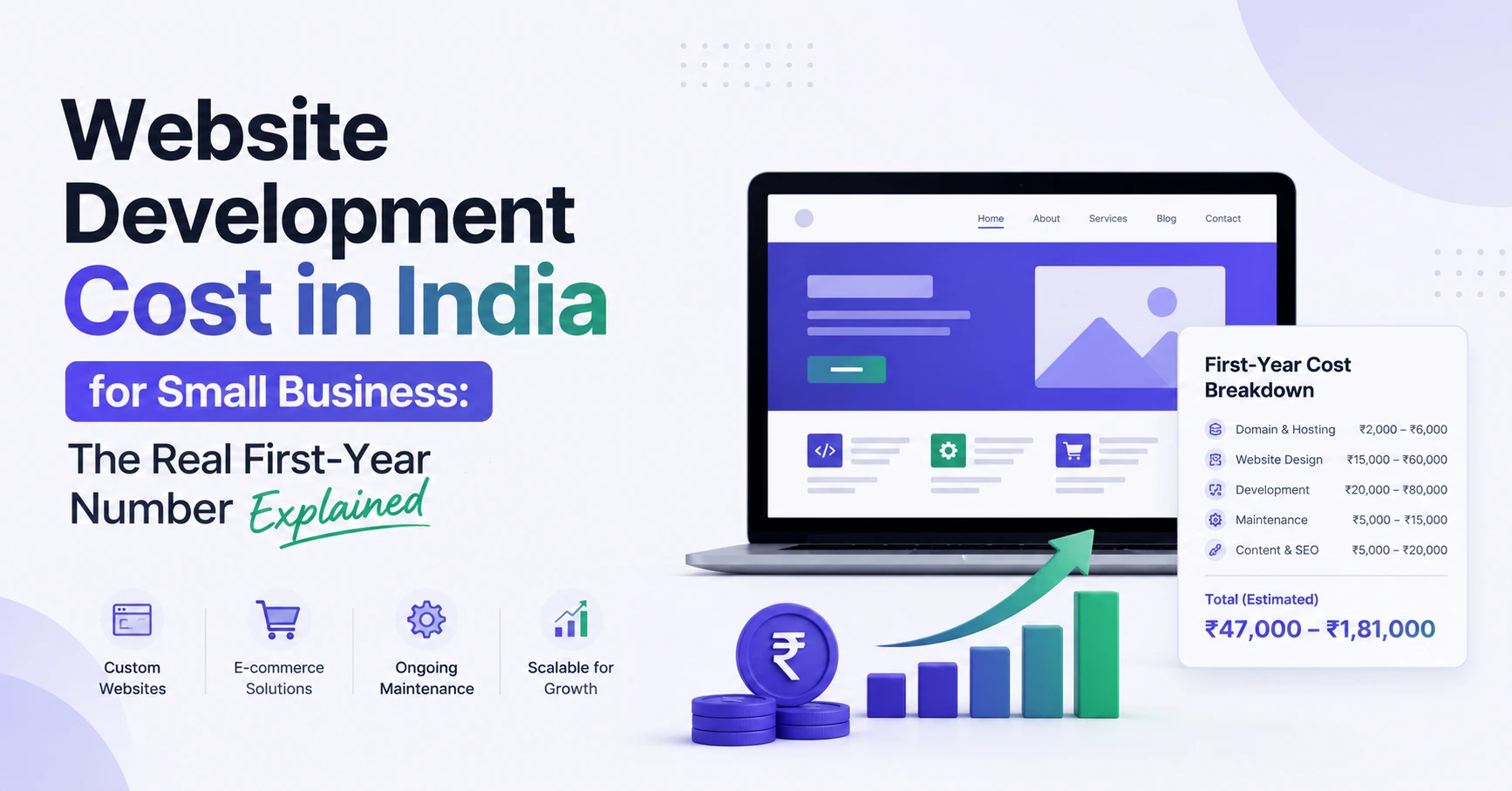
But there's a second problem nobody warns you about, and it costs more than the confusion. The number on the quote is not the number you'll spend. For a D2C brand in India, the build is usually somewhere between a quarter and a third of what the website actually costs in year one. The rest arrives quietly — 18% GST on the invoice, payment gateway fees on every order, app subscriptions, the maintenance retainer you didn't budget for.
This guide gives you both numbers: honest build ranges for 2026, and the full first-year cost of ownership for a small Indian ecommerce brand. All figures in INR, all sourced from live market pricing.
What a website actually costs to build in India in 2026
Website development cost in India for small business sits in a wide band because "website" describes four genuinely different products. Here's what each tier buys, based on current agency and freelancer market rates:
| Tier | Build cost | What's actually included | Right for |
|---|---|---|---|
| Template setup | ₹15,000 – ₹40,000 | Free or ₹8k premium theme, minimal customisation, up to 20 products, one payment gateway, standard pages | Testing demand before you have revenue |
| Configured store | ₹40,000 – ₹1,20,000 | Premium theme with real customisation, 50–100 SKUs, collection architecture, shipping zones, basic on-page SEO, mobile QA | Most first-time D2C launches |
| Custom-designed store | ₹1,20,000 – ₹3,00,000 | Bespoke design, custom sections, bundles or subscriptions, ERP/CRM integration, conversion-focused PDP and checkout work | Brands past roughly ₹10L/month |
| Custom or headless build | ₹3,00,000+ | Custom frontend on Shopify's APIs or a fully bespoke stack, custom checkout logic, multi-store | ₹1 crore+ annual revenue |
Most Indian small businesses land in tier two. If you're launching a D2C brand with 50 to 100 SKUs and you want a store that actually converts rather than merely exists, budget ₹80,000 to ₹1,50,000 for ecommerce website development from a competent agency.
Freelancer quotes for the same scope typically run 40–60% lower, and the tradeoff is availability, not necessarily quality — a good freelancer beats a bad agency every time. The risk is what happens in month seven when they take a full-time job.
Be suspicious of anything under ₹15,000 in 2026. That price only works if someone installs a theme, uploads your logo, and disappears.
At the top two tiers you're no longer buying a store, you're buying a custom website build — and the pricing logic changes completely, because you're paying for design and engineering hours rather than configuration.
What drives the number up
Four things move price more than anything else, and understanding them lets you compare quotes that are actually pricing the same work:
- SKU count. A 30-product store and a 600-product store are different projects. Taxonomy, filtering, and variant management all scale non-linearly. Product data entry is usually billed separately at ₹50–₹200 per SKU, which is why Shopify store development in India is quoted per catalogue size rather than as a flat rate.
- Integrations. Every connected system is development time. A reviews app is trivial. A Tally or Zoho ERP sync with custom API work is not.
- Design origin. Theme customisation versus design from scratch is the single biggest line item difference in most quotes.
- Who's building it. Indian agencies bill roughly $25–$60/hour blended across a team. That's a fraction of US or UK rates for equivalent output, which is exactly why web development is one of India's largest services exports.
If you already have a store and you're pricing a rebuild rather than a launch, the arithmetic is different again — migrating or upgrading an existing site usually costs less than a fresh build, but only if the data model survives the move.
The costs your quote almost certainly excludes
This is where a ₹90,000 project becomes ₹1,60,000. Ask about each of these before you sign.
GST at 18%. Development services attract 18% GST. If your quote says ₹1,20,000, you're paying ₹1,41,600. Reputable agencies quote inclusive or state it clearly. Some don't, and it lands as a surprise on the final invoice.
Domain. ₹800–₹2,000/year for a .com or .in. Almost never in the build quote.
Hosting. ₹3,000–₹30,000/year if you're on WordPress. Zero if you're on Shopify, because it's bundled into the subscription. This is the hidden variable that makes WordPress development look cheaper upfront and often isn't over three years.
SSL. Should be included by default in 2026. If someone charges you extra for basic SSL, treat it as a signal about everything else in the quote.
Product photography and copy. The most consistently underbudgeted item in Indian D2C. A 50-SKU catalogue shot properly runs ₹15,000–₹50,000. Your developer is not going to write your product descriptions, and AI-generated copy on a fashion brand reads exactly like AI-generated copy on a fashion brand.
Search visibility. A built site is not a found site. Technical SEO foundations are sometimes included; content, link acquisition, and ongoing SEO services never are. Budget them as a separate line or accept that traffic will come from paid channels only.
The renewal trap. Some agencies build on a premium theme or paid plugin stack, absorb the first-year licence in the quote, and pass you the renewal in month thirteen. Ask for a written list of every paid dependency and its annual cost before you sign — it's one of the warning signs worth checking before you hire any web or SEO agency.
The running costs that decide whether the site pays for itself
Here's the part almost no cost guide covers, and it matters more than the build price if you're selling products rather than services.
Payment gateway fees
Razorpay's standard domestic rate is 2% plus 18% GST across cards, UPI, netbanking, and wallets — an effective 2.36% on every prepaid order. Premium methods like EMI, Amex, and Pay Later run 3% plus GST. Cashfree and most major Indian gateways cluster in the same band. There's no setup fee or AMC on Razorpay's standard plan, though some competitors charge annual maintenance of ₹3,600–₹4,999 regardless of volume.
Two things founders get wrong here. First, UPI is not free to you — the government's zero-MDR mandate applies to the bank-to-bank rail, but gateways still charge a platform fee for routing, checkout, and webhooks. Second, chasing a 1.75% headline rate over 2% is usually a mistake: a gateway with a 93% success rate keeps meaningfully more of your revenue than one at 85%, and that gap never appears on a pricing page.
If you're on Shopify and not using Shopify Payments, note that Shopify stacks its own transaction surcharge on top of your gateway fee, and that surcharge drops as you move up plans. On ₹50L annual GMV, moving from Basic to Advanced can save roughly ₹70,000 in surcharge alone.
Platform subscription
Shopify Starter runs about ₹399/month for selling through WhatsApp and Instagram without a full storefront. Basic is roughly ₹1,994/month on monthly billing and is the correct starting point for most Indian D2C brands. WooCommerce has no subscription but shifts that cost into hosting, plugin licences, and the developer time you'll spend keeping it patched. We've broken the platform decision down properly in our guide to Shopify development for scaling ecommerce brands.
Apps and plugins
Reviews, upsell, size charts, loyalty, email. Budget ₹1,000–₹3,000/month early, and understand that this line grows faster than any other as you add features.
WhatsApp — non-optional for Indian D2C
COD drives 40–60% of Indian D2C orders, which makes order confirmation and NDR resolution a margin issue, not a nicety. WhatsApp Business API costs stack in two layers: Meta's per-conversation fee (roughly ₹0.11 for utility messages, ₹0.78–₹0.99 for marketing) and your BSP's platform fee, which ranges from ₹0 to ₹25,000/month depending on provider. A small brand sending only order-status messages can run this for ₹3,000–₹5,000/month all-in.
Brands with strong repeat rates eventually push retention into an owned channel instead. That's the logic behind converting a Shopify store into a mobile app — push notifications cost nothing per send, where every WhatsApp marketing conversation is metered.
Shipping and RTO
Not strictly a website cost, but it's the number that determines whether the site is profitable. Shiprocket's advertised floor is ₹20–₹26 per 500g, but COD charges, zone markups, GST, and fuel surcharges push real landed cost well above that. And RTO is brutal in Indian fashion — industry averages run 25–32% for apparel, 15–20% for beauty, with COD share as the biggest single driver.
The reason this belongs in a website cost article: your site's design directly moves this number. Clear sizing, honest photography, a COD confirmation step, and address validation at checkout are development decisions that show up in your P&L as reduced returns. It's the same principle we cover in what actually makes a website work — design choices are commercial choices.
Maintenance
₹5,000–₹25,000/month depending on scope. A site with no maintenance plan degrades — plugins break, themes fall behind platform updates, and the security patch nobody applied becomes the reason you're rebuilding in eighteen months.
A real first-year budget: D2C brand at ₹5L/month
Say you're launching an apparel brand on Shopify. 50 SKUs, custom-themed store, targeting ₹5,00,000/month GMV with a 50/50 prepaid-COD split. Here's the honest year-one website cost:
| Line item | Year 1 cost |
|---|---|
| Build (configured store, custom theme, 50 SKUs) | ₹1,20,000 |
| GST @ 18% on development | ₹21,600 |
| Product photography (50 SKUs) | ₹15,000 |
| Domain | ₹1,200 |
| Shopify Basic × 12 months | ₹23,928 |
| Apps (~₹1,500/month) | ₹18,000 |
| Payment gateway @ 2.36% on ₹30L prepaid GMV | ₹70,800 |
| Maintenance retainer @ ₹8,000/month | ₹96,000 |
| Total, year one | ₹3,66,528 |
You said yes to a ₹1,20,000 quote. The website costs just over ₹3.6 lakh in its first year — roughly 3x — and that's before a single rupee of shipping, inventory, or ad spend.
This isn't an argument for spending less. It's an argument for planning the whole number. Founders who budget only for the build run out of money at month four, right when the site needs its first round of conversion fixes, and end up with a store that works but doesn't sell.
For a sense of what tier-two and tier-three builds look like finished, our work with La Ellore is a useful reference point — a premium catalogue where photography and PDP structure carried most of the conversion weight.
How to read a quote properly
Four questions that separate a real proposal from a number on a WhatsApp message:
- Is GST included, and what's the payment schedule? Get it in writing.
- List every paid dependency and its renewal cost. Themes, plugins, apps, licences.
- What happens after launch? Thirty days of bug fixes is standard. A maintenance retainer is separate. Confirm which you're getting.
- Who owns the code and the accounts? Your domain, hosting, Shopify, and analytics should be registered to you, not the agency. This is the single most common way small businesses get held hostage.
Then ask for two references in your category that you can actually phone. A five-minute call tells you more about communication and reliability than any deck — and any agency worth hiring will have projects they're happy to show you.
FAQ
How much does a website cost in India for a small business?
Most Indian small businesses spend ₹40,000 to ₹1,20,000 on a professionally built, mobile-responsive, SEO-ready website. Below ₹15,000 you're getting a template installation with minimal customisation. Add 18% GST, and budget separately for hosting, content, and maintenance.
How much does an ecommerce website cost in India?
A launch-ready Shopify or WooCommerce store with up to 50 products runs ₹40,000 to ₹1,20,000. Custom-designed stores with integrations sit at ₹1,20,000 to ₹3,00,000. Fully custom or headless builds start around ₹3,00,000.
Is Shopify or WordPress cheaper for an Indian D2C brand?
WordPress with WooCommerce has a lower monthly cost but higher hidden cost — hosting, plugin licences, security patching, and developer time. Shopify costs about ₹1,994/month on Basic but bundles hosting, SSL, and PCI compliance. For most first-time D2C brands under ₹20L/month, Shopify's total cost of ownership works out lower.
What are the ongoing costs of a website in India?
Hosting (₹3,000–₹30,000/year on WordPress, bundled on Shopify), domain renewal (₹800–₹2,000/year), apps or plugins (₹1,000–₹3,000/month), maintenance (₹5,000–₹25,000/month), and payment gateway fees at roughly 2.36% of prepaid revenue.
Does website development cost include GST in India?
Not always. Development services attract 18% GST. Some agencies quote inclusive, many don't. Always confirm before signing — on a ₹1,20,000 project it's a ₹21,600 difference.
How long does it take to build an ecommerce website in India?
A configured store with 50 SKUs typically takes three to five weeks. Custom-designed stores run six to ten weeks. Anyone promising a custom ecommerce site in seven days is selling you a theme installation.
Planning your build?
We build ecommerce stores for Indian D2C brands — Shopify, WooCommerce, and custom — and we quote the full first-year number, not just the build.
If you want a straight answer on what your specific project should cost, send us your brief. No sales call required to get a range.